-
Holiday Hoopla
The holidays always seem to come upon us like a cat trying to do a jump scare. They hide, sometimes in plain sight, then they use all their force to knock into us, usually ending with screaming, and sometimes crying. Oh yes, the holidays. For those of us with neuro divergent brains, holidays cause so much fret and worry, and many of us love when they are over. There are ALWAYS highlights, of course, but those can be far and few between, and some of us prefer the dark solitude of a closet.
I was never into decorating for the holidays. I would decorate the tree with MY ornaments that I decorated with EVERY SINGLE YEAR. I would put out MY Nativity set, EVERY…SINGLE…YEAR. Those were routines for me. My brain was cool with those. Things that others usually did, such as hang Christmas lights and wreaths, bake cookies and make extravagant holiday dinners…yea…no thank you. For years I never understood my opposition to trying new things at the holidays, but my diagnosis of Fetal Alcohol Syndrome blessed me with understanding. Give me ROUTINE, I am good. Throw in lights and Santas with music, dancing and bells that jingle, and you will come face to face with dysregulated Rebecca. This Rebecca presents As one that has a short temper and wants what she wants when she wants it. As a child I think I masked it well, except you would not see me joyfully asking to help my mom cook Christmas Dinner, or asking my dad to put the lights up outside. If I was asked to help, I would. I would do it quietly, and then fall asleep early, because man oh man my brain had too much. I find myself able to articulate now to others why I don’t cook the big meal on Christmas or Christmas Eve (not to mention my cooking skills are novice at best), and why I don’t partake in decorating the house for Santa and his reindeer. It is just too much Hoopla. Making meals has too many directions and you have to multitask, and can someone PLEASE TELL ME how you make each dish ready to consume at the same time? I will bow out, thank you. I will gladly eat the meal though, and do the dishes. Dishes are routine for me, and I love the hot water running over my hands.
Knowing one’s limitations in high stress and highly stimulated environments is one of the keys to keeping their cool. This is why those who are not self aware of their limitations during the holidays struggle to keep calm. I lose my temper and become dysregulated at times even if I know my limitations. Why? It is because I am a people pleaser, and I think to myself, “I can handle this just fine. I don’t want to let others down.” Unfortunately, I may keep it together for most of the time, but then fall apart once I am home in my safe place. Then my family looks at me as I retreat to my room and close the door, or go into my son’s closet where the walls are thick and I feel surrounded by silence. All the things can happen. Or none of them can happen. Our brains surprise us every single moment, don’t they?
I have compiled a few strategies for families familiar with neurodivergent brains around the holidays:
- Pajamas. Comfy clothes. Let the children wear them. I know some families have their children get dressed nicely in scratchy jeans or khakis and a crisp button down shirt where the tag itches in the exact spot you can’t seem to find. Or in what I used to call Polly Flinder Dresses: the dresses that are crinkly and poofy and scratchy to the touch. They feel like those 3D photos when you touch them. I know these clothes look beautiful, and Gap Kids will want your children in their next photo shoot. Or will they? The children will start to melt down. Their smiles will become frowns and faces of anger. Tears will spring from their eyes, as the clothes textures consume them. Not to mention the routine of wearing comfy clothes was changed. So, let them be comfy, I promise you will thank me
- Let them Eat Cake: Holiday food tables are overwhelming. You have all different types of food, all different smells smashing into one another, creating yet other, interesting smells. The foods are then put on 1 plate which is not big enough to make sure no foods touch each other. Some of us neuro divergent people like to eat the same thing every single day. So, why change it? You all can grab your Roast Beast and Figgy Pudding off the long tables where you have to squeeze by or crawl under to get to the other side. Let us have our normal foods.
- Taking a Stim Break: For anybody who enjoys Chevy Chase and National Lampoon’s Christmas Vacation can visualize the scene that immediately pops into my head when I think OVERSTIMULATED. The extended family all comes to the house…at ONCE. There is the sound of the doorbell multiple times, the clicking of the door as it opens, all the different voices holding ten different conversations with the same three people, the slobbery, wet kisses from the aunts, and YES, the smell of a fart committed by 102 year old Uncle Lou. All of these lovely noises and acts that stimulate every sense of our body often make us want to jump out of our skin, and into a weighted blanket in a quiet closet with a heavy door with a deadbolt. Make sure those who need stim breaks have a safe space to go. If you are out and about at a relative or friend’s house, scope out a place. Dysregulation is horrible for everyone involved.
- Presents for Days! Ok, maybe not days, but lots of presents all at once can trigger dysregulation. So, maybe opens a couple the night before, and a couple the day after. Maybe do them all in one day, but throughout the day.
- Make it an early night. Even those that are always on top of keeping dysregulation to a minimum, their brains are still working 5 times as hard as other brains. We still mask. Come on, we all do it. Masking is exhaustsing. We don’t even know we do it sometimes, but it is part of our brains. So, we are exhausted by 5 or 6 PM. We are ready for bed. Ready for quiet.
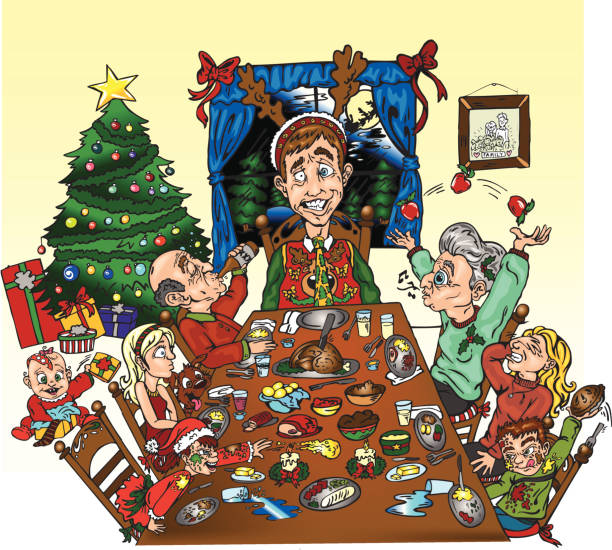
Oh my gravy! What has gone wrong, ahhh, you gotta love that good ol’ holiday feast! YUMMMMMY!!! I drew this line art then colored in illustrator. What fun! -
RunFASD 2024!
-
GOOD GRIEF

I had the amazing opportunity to attend the 9th International FASD Conference in Seattle, Washington last week. One word that comes to mind is “WOW.” About 100 self advocates, ranging in age from teens to early seventies were in attendance. Chatting with others who like to talk as much as me, and can’t read directions, and have so much empathy, all of this was amazing for my soul.
I was asked to be filmed for a CDC documentary prior to the conference starting, and was asked about my diagnosis of Fetal Alcohol Syndrome. I was asked the age I was, who gave me my diagnosis, and how I felt after I received the diagnosis. I explained to the film maker that upon receipt of my diagnosis I went through the stages of grief. It was the first time I had said that out loud. I have thought about it some, but to go live and say it, that was a first. There are 5 or 7 stages of grief, depending what literature you read. I studied the 5 stages of Grief by Kubler Ross when I was in college. Publicly acknowledging I went through this cycle after my diagnosis was healing for me. People may ask how the Grief Cycle has anything to do with being diagnosed with an FASD. Well, I grieved for what could have been. Without brain damage, what could have been different? I love the life I have lived so far, and I have been mostly successful and happy.. Although, I would be lying if I told you there have been no hardships. Many of my hardships n life I attribute to having an FASD. My impulsivity has gotten me into trouble with money and relationships. My lack of understanding cause and effect has had me make some questionable choices in life, and had to deal with the not so great consequences afterward. I think my college career would have been much smoother. I will never know, but I still experienced grief for what may have, and probably would have been.
Shock and Denial is one stage: When my mom rattled off the symptoms of FASDs she had read on a pamphlet from the adoption agency I was adopted from, my eyes widened, and the tears formed. The symptoms were me! Holy shit! But in the same breath, I thought, “NO way. NO way have aI gone through life without knowing this. I am successful in life, I can’t have this!” Yes, I thought that, because I didn’t know much about FASD at the time,.
Pain and Guilt is another stage: Yep, I felt this one. Why? I felt pain and Guilt for the way my life may have been, had my life giving mom not drank during pregnancy.
Anger: This is a fun stage. I felt it in my bones, in my soul. I kept it inside though. I never let it out., at least in public. Alone, sometimes I would curse at her, angry tears would fall. Never in public though. HELL YES I was angry at my life giving mom drinking during her pregnancy. This anger was strong before I knew she was an alcoholic. Before I realized she had an addiction, most likely to numb the pain she went through in her life as an orphan and foster child. Even after I realized she had an addiction, I still had anger, because I didn’t know, and still dont’ know much about addiction. I know what can drive one to addiction, but not much about why it is so hard to stop and get out. I saw a woman at an FASD Conference in Minnesota years back, and she was a recovering addict. She said to hate the disease, not the person. That hit my heart full on, like a football player tackling an opponent. Hard and fierce. At that moment, my anger for my life giving mom subsided. There are days when I get frustrated with her though. When I have a rough day due to my dysregulation or my sensory issues or not understanding a cumbersome task at work, I get frustrated. Not at her so much anymore, but at the disease. Damn addiction.
Depression: Hmm…sometimes when I have had a crappy day because of my FASD (a day at work when I can’t get the hang of a new system, or how to write up a report), I will get sad, knowing these days will always be there. They will never stop. I can learn to do hard things, but it may take me longer than if my brain wasn’t wired differently. These realizations make me sad sometimes.
Bargaining: I try to think if I ever bargained with my life after receiving my diagnosis. I know I ruminated on details of FASD, trying to make sense of all that it is. I would wish, I still do on hard days, that I could go back and change the past. Change my life giving mother’s past. But then I most likelyy would not be here, so there’s that. I like being alive. I like my life.
Acceptance: I think over the past 10 years I have come to accept that my brain works differently, and that I have good supports in place to be successful. I have come to accept that there will be pitfalls, and there will be days I do things wrong, hurt people, have to say sorry, and accept consequences. What has helped me accept my diagnosis is that I have become a self advocates, and an advocate for those who are learning to have a voice. Advocacy gives power and light to a disorder that can be so dark and lonely.
Not only may us with an FASD go through the Grief Cycle, but caregivers may as well. It only makes sense that they would grieve about a life that may be different than what they envisioned. Please understand, the word GRIEF, like the words FETAL ALCOHOL SPECTRUM DISORDERS, is not a bad word. It is a spectrum of feelings, each one validated in its own way, each one unique. Having grief for a life that could have been is normal. Each of us misses something that is now gone, or that could have been. GRIEF helps us through the hard times, it is that bridge to being able to say, “This is going to be ok.”
These stages of grief have no order, they have no time limit. Some may be repeated multiple times, some may only creep up once in a while. Sometimes a stage will come out of nowhere. My advice is to sit with the Grief. Let it go through you, talk to someone about it if it helps. But most importantly, feel it. There is no shame in grief. Through grief, the soul heals just a little bit.
-
FASD Cheat Sheet
-Stick to 1-2 step directions;
-Repeat when asked;
-Idioms: We may take them literally, just sayin’…. May want to be very concrete when speaking;
-Give us more time than some need when processing directions;
-lists and photos work to get things done;
-What we remember one day we may not the next: How to make cereal, how to tie our shoes, how to get from point A to point B;
-We have dysmaturity, think younger. Like ½ our age younger. Sometimes not that young;
-Yes, we have splinter skills: High aptitude in one or more areas, low aptitude in other areas;
-We want to please, make people happy;
-Many of us are Sensory seekers and sensory avoiders. WEIGHT can help many of us regulate our emotions and physical jitters;
-IT IS NOT THAT WE WON’T, IT IS THAT WE CAN’T (at that moment, maybe longer).
-EVERY DAY IS A NEW DAY FOR US. OUR BRAIN RESETS EVERY DAY.
-It is OK to Get Frustrated and Exhausted. Just try to remember, us living with an FASD feel those feels too. ALL THE TIME.

-
Inside
Multi-step directions
Break them down, so I can understand
Tell me it’s ok, if I use my hand
To add three plus three
So I know what the answer will be
Please don’t laugh when I go to bed at eight
And then sleep for 12 hours straight
You see, for my brain to focus and learn at its best
It takes a lot of energy, and a lot of rest.
I have damage to my brain
Often, it can be a drain
To my social and emotional state
Many of us have issues showing up late
Cause and effect, what is that?
Impulse control issues, and many love to chat
Executive Functioning is where most of us lack,
All we ask is that you have our back
Take time to listen, take time to see
That we are so much more than our FASD.

-
CLOSE YOUR EYES
I am going to propose a scenario to each of you. Close your eyes. Go ahead, close them. Ok…now I want you to envision a foster child. Well, a teenager. 18 years old. Let’s name them Harrison. They are considered “An Adult” by state standards. The state doesn’t consider the trauma this child has been through. It doesn’t consider that on paper, Harrison is 18, but emotionally and socially they are half of their chronological age. So, this 18 year old “adult” leaves foster care to go find a job, find a place to live, and support themselves. Harrison goes to interviews, and they get a couple job offers, because they interview so well. Their verbal skills are amazing, maybe at a 25-year-old age level. They get excited because they nailed a job! Harrison goes to their first day on the job, but they don’t last more than a week. Their first day they show up late, because they have time management difficulties. The second day they are late again. Harrison sets an alarm, but their mind can’t calculate how much time is really needed to get ready in the morning. Fifteen minutes is NOT enough time to get out of bed and then remember the tasks one should complete before exiting the door. Fifteen minutes in Harrison’s mind IS enough because they are only calculating how long it takes to arrive a to work once they are out the door and actually on their way to work.
The employer has no idea about Harrison’s FASD because this 18-year-old doesn’t want to ruin their chances of employment. Harrison doesn’t understand the cause and effect of being late. They do understand that their disability is not understood in much of society though, so they keep it close to their heart. By the end of the work week, this 18-year-old is brought into their boss’s office. The boss has them sit down. They proceed to tell Harrison that this job isn’t going to work. They were late every day and kept asking how to complete the same round of tasks, over and over again. Harrison didn’t think to write down the instructions, because up until now, they had been written down for them, in a way they understood. Using pictures, short sentences, simplified. The employer had instructions for tasks, but they were in paragraph form, with words Harrison didn’t know the meaning to. Which the boss wouldn’t expect to be an issue because Harrison did incredible in the verbal interview! There is also the trauma Harrison lived through, that was never disclosed to the employer, because this “adult” really wanted the job, and they know the stigma attached to trauma. So, when an employee came up and attempted to tell Harrison that they were doing things incorrectly, Harrison saw the employee as a threat, as someone telling them they weren’t good enough. In turn, Harrison started yelling, became defensive and used profanity. Then Harrison ran out of the office building and went home.
In addition to Harrison attempting to get a job, they are also looking for a place to live. It can be an exciting time for many. A place to call your own! For Harrison though? This is what it will look like: Harrison struggles with money. They know how to count money and know how much they have at one time. Where they will struggle is rent. Utility bills. Groceries. They have impulse control issues, so Harrison will see something on Amazon that they think they need at that moment. The money that is for rent, utilities, and groceries. They will use it for this item on Amazon. They will not realize him buying the item on Amazon will subtract from the amount of money they have for rent and utilities. Cause and Effect are not Harrison’s strong suit. If they decide to live alone, the responsibilities will be all on them. The cleaning, the grocery shopping, paying everything on time. Harrison doesn’t know how to mark payments and appointments on a calendar. When they try, they write them down on the incorrect date and time. This means rent will be paid late. This means Harrison will not be long for this apartment they scored.
Yes, Harrison is 18 years old on paper, but do you all see what I see when I describe this “adult?” I don’t see an adult. I see a scared little kid wondering why the world isn’t treating them right, wondering why life is so tough for them, when they see other 18-year-olds out there making it just fine. Neurotypical people, that is. This “adult” has the emotional age of about a nine- or ten-year-old. Maybe a little older, maybe a little younger, depending on what happened in their life. This 18-year-old no longer has that scaffolding they had for years. Someone to help them make their appointments on time, someone who understood their “quirks” and how they learned. So essentially, a child, nine or ten, is going out into the real world, attempting to live in a world where people see them as 18. I know many states do have supports in place to help those at age 18 to stay in the system and get accustomed to the real world. Yet, even at 21 or 25, when they pack their bags to go onto the streets and live their lives, emotionally? They are still only eleven or twelve years old. Now I ask you, what eleven- and twelve-year-old would you set free on the streets to make a life for themselves, with no support?
***Please understand, I know many foster care systems are incredible, and do their best to prepare their children for the outside world. Unfortunately, many of the kids want to be independent and are head strong, tell everyone they can make it on their own. They don’t ask for help; they want to figure it out. Many have been burned asking for help.. Mistrust of humans has set in.. Unfortunately, many don’t figure it out. They end up on the streets, making bad decisions, because their brain needs external help. My hope is that little by little, people can help those with an FASD live interdependently or independently and hold down a job. My hope is that those with an FASD will break down the walls they have up, and allow that help in. Everybody needs a little help sometimes.

-
TRAUMA
TRAUMA: It has no boundaries. It does not discriminate. EVER. There are no age ranges of who it effects.
It evolves differently in each of us. Different events come and trigger us. I believe every single person has had some trauma in their life, at some point. On July 8, 2023, my best friend’s old house caught fire. Her son, my son’s best friend, was the only survivor. His baby sister, my surrogate daughter, died. Five years old. Her dad…didn’t make it. He and I had become friends since Covid. He was a wonderful dad. She was the most beautiful little girl. They didn’t deserve to die. They had so much life to give. So, so much. That little girl took her first steps in my house. She gave the best hugs. After she passed, I found out from teachers that she was the one who helped all the kids in kindergarten open their lunches if they needed help. Helped with the baggies, with the juice boxes. Never asked, just did it. She was a sassy li’l thing though. Her brother jumped out his second story window. He survived. No broken bones. He was all who survived. 4 people died. The world lost 4 beautiful souls.
I wasn’t in town when the fire started. I woke up to Facebook posts about it. My first text was to the girl’s father, asking if he was ok. I would discover soon enough that he wasn’t. I was not 100% sure at that point it was their house. Next, I called my best friend, the little girl’s mom. She was screaming, she had come on the scene and didn’t know who was out and who was still inside. I called her about an hour later. She couldn’t speak. I told her I would name the people in the house, and she would say yes or no as to whether they were still with us. “Emily,” I whispered. “No.” I fell to my knees in the parking lot, lost it. My youngest son was next to me through every post I read, every phone call I received, every email, every text. He was traveling back with me. Emily was only 5. That was my best friend’s baby girl. I knew at that point Anthony, her son, had gotten out. I found out that Emily’s great uncle, and her dad’s girlfriend also never made it. Her dad passed at the hospital. Tragedy…trauma.
I see her everywhere; I hear her talking to me. I hear her footsteps running to give me a hug. I hear her throwing a temper tantrum as she did many times when she had to leave our house. The last time I saw her was in May of this year, in my backyard, doing cartwheels she had just learned. She was running around with her brother and my two boys, playing tag, as mom and I watched, laughed, and talked.
Trauma: I see fire trucks, and my breathing starts to increase slightly. I hear sirens with the same result. I drive past where the house used to be, daily. My breath sputters. My family has yet to have a fire down on our patio, since the tragedy. We have been to other houses with bonfires. Those have been ok. I think because it is at my home, where she used to run around, and I used to constantly tell her to, “slow down.”. Events can occur, and one may wonder how that event triggers a trauma response. For me, I recently found a pink baby shark toy under my son’s bed. My brain thought of Emily. Baby Shark was one of her favorite shows as a toddler. My oldest used to play the theme song on our keyboard, and then she would try to play it and sing along. I then remember the tragedy, that she is no longer with us. The heaviness in my chest comes back, the tears start to surface. I am then catapulted to the times we shared together. I get chills in my heart, my body, my soul. Trauma can come out of nowhere.
I have a brain disorder. Permanent brain damage. I have Fetal Alcohol Syndrome. One of the ramifications of this disorder is perseveration. When trauma occurs, getting through it and not having it come back time and time again can be so tough. Our brains fixate on events, and what events it chooses vary. For me, Trauma is one my brain catches in the repeat loop. I keep going over the events, in detail, what I know, how I felt, how I feel, what s different now, who is gone, who survived, and how are the survivors going to be affected. A negative that comes with perseveration for sure. One’s brain may be released from the repeat loop of traumatic events, but then something happens, and the trauma is triggered again. The perseveration begins again. Sometimes less intense, sometimes more intense, sometimes the same. How do we get through it? Those of us that are experiencing perseveration? We find our people. We find our supports and talk it out. Whether that be a counselor, family, friends, find your people. Talk to them. Let them help you through it. Perseveration is our brains trying to process information. Sometimes it just has trouble and gets stuck. Like an old school record player that skips…over…and over again. This too shall pass.
My grieving comes in waves. Usually when I am alone. My tears, there are many more. I know Em is with her dad, and I know they are ok. Not in pain. My heart aches for what we lost, but also for my best friend and her son. The survivor’s guilt he must feel. He has started to talk about his dad and his sister more. That is how he is dealing. He is my “other son “. I hope he heals, gets the help he needs, and grows up to be a strong, kind young man. The man that his dad was helping him to become.
So those of you living with trauma, I see you. I feel you. My feels may be different from yours, but the effects are the same. They can incapacitate you, freeze you in time. They can make you weak with tears. No matter how you experience trauma, IT IS REAL, and IT IS BIG. We can work through it, but everybody has their own timeline. Be patient and be present. That is all we ask.

-
The Po Po

I love to watch old school reality shows. My most recent show? COPS. Yep. Here is a plug in for free Pluto TV my friends. They play COPS LIVE. I love looking at the 90s motifs, the big, clunky police cars and the uniforms. One thing always remains constant in the police world. Reading the criminals their rights. I am much older now then when Cops came out as one of the first Reality Shows. I now see the show through a different lens. The lens of one with an FASD.
I was recently sitting and watching the show, and taking notes in the margins of a scrap piece of paper. I am not saying the perpetrators all have an FASD, but what I saw was the protocol of the police and how certain aspects could be confusing and frustrating to those with an FASD, and could result in an altercation with the Po Po. Here are some nuggets I gathered:
- In every scenario, when a suspect is arrested, the officer recites Miranda Rights: “Anything you say can and will be used against you in a court of law.” -That sounds straight forward to a neuro-typical brain, right? Many people with an FASD would be overwhelmed and in fight or flight mode, and may think that means do not speak AT ALL, no matter what. Don’t tell them my name, my age, or where I live. If they are asked, “Do you want water?” they may not answer. After all, they are just following directions. I get that protocol is protocol. This is just an obstacle that we can face.
- I watched a few shows where the officers talked about waiving rights. To this day I get confused as to what that means. It is not your everyday coffee talk. One with an FASD may not know that word, and maybe they think it means they will get to be released, no questions asked.
- One suspect was caught and asked if he had “anything on him.” Hmm…Abstract language my friend. On him? Our brains are very black and white, and while YES we MAY UNDERSTAND that lingo, there are those of us with brain damage that would think, “Of course I do! I have underwear, socks, shoes, pants and a shirt on me! What kind of question is that?” So we answer yes, and the barrage of questioning continues. The cop gets so irritated because they search you, and there are no drugs or weapons anywhere on you! Well of course not, but I have clothes on me, Man! In the episode I watched, the suspect was a 17 or 18 year old kid who was holding drugs in his mouth. Now, most likely he was hiding them from the police, but, for shits and giggles, let’s say his brain is literal. The drugs are not ON HIM, but INSIDE him.
- Multi step directions. Police officers are notorious for this, and rightfully so, they have a job to do. It is hard to change a way of thinking and doing one has been taught in schooling. “Get out of the car facing backward and walk toward me.” Some with an FASD brain would have gotten out of the car backwards, then turned around and walked facing forward to the officer. Who walks backwards? That is just silly, right? The officer says it because it is a safety concern. Oh, and don’t forget put your hands up. Some would forget that part and would be tackled to the ground, not understanding what they had done wrong. THEY HAD followed directions. They had not heard him asking to put their hands up. Or, “Get out of the vehicle with your hands up!” HOW IN THE WORLD ARE THEY SUPPOSED TO GET OUT OF THE CAR IF THEIR HANDS ARE UP? Many of our brains hear every 2nd or 3rd word. Think about that for a second.
- Loud Voices: I know police have to yell at suspects if they feel they may be in danger. I understand completely this is a necessity. I am just going to say it may cause a suspect with an FASD to react badly, such as covering his ears, or even running away from the noise. He isn’t running from the cops, but from the noise. Again, I know yelling is necessary for safety.
***I want my readers to know I understand police protocol is necessary for safety reasons. I am just giving my viewpoint on what could go awry when one with an FASD gets caught by the cops, and why things go sideways. I do think education of FASD and neurodivergent disorders could be extremely beneficial to law enforcement. I know protocols are slow to tweak, and there is usually push back. We have to try though. Change is always there, waiting in the wings. It just needs to be seen, acknowledged, and then action can begin.
DID YOU KNOW?
–$30,945.00: Includes the costs associated with juvenile and criminal justice per person with an FASD, per year. Due to how an FASD brain can struggle with lack of understanding cause and effect and impulsivity, those with an FASD being involved in criminal activity is not uncommon. (60% of teens and adults with FAS have been in the legal system and 35% incarcerated for a crime).-www.fasdunited.org, 2021.
*This amount of money is staggering to say the least. It is probably a conservative number also. Think about those in the criminal justice system that have not been diagnosed?
-Those with an FASD are 19-40x more likely to be involved in the Criminal Justice Syestem (2022, www.policechiefmagazine.org)
–23-36% of those in the Criminal Justice System met FASD Criteria (2022, www.policechiefmagazine.org)
–60% of adults and adolescents with an FASD report contact with the legal system (2022, http://www.policechiefmagazine.org)
As a society, we need to do better. We want to educate, but we need opportunities, and we need the public and the criminal justice system to listen. We can’t do it alone. We need supp
-
I’m Sorry
We have all heard these words. Throughout so many seasons, for so many reasons. The I’m Sorry I want to discuss is the one I hear on occasion when I divulge my diagnosis, and how I got it. I had a table at a farmer’s market in my town over the summer for the RunFASD VIrtual 5k 2022. A man came over and asked what RunFASD was all about. I explained what FASD is, how it occurs in 1 out of 20 school age children in the United States, and is 1.5 times as common as autism. I explained my story and my diagnosis. “Oh, I’m sorry.” Came out of the man’s mouth. I was taken aback for a couple seconds. Then I just said, “Don’t be sorry. This is a teachable moment.” He smiled, and walked away.
I was recently at another event, and I was discussing my diagnosis with a woman. “I’m sorry.” Again. I get it. I don’t know what other answer I would expect, to be honest. If roles were reversed, I would probably say the same two words.
Why though? Why do people choose to answer with, “I’m sorry?” These words are the one people say when they aren’t sure how to respond. They are easy to say, and the people mean well. I mean, FASDs are caused by a woman drinking during pregnancy. Of course it is a cause to be sorry about. Saying, “I’m sorry” also comes from a lack of awareness and education about FASDs. The words come from the stigma that surrounds FASDs. Please try to understant, FASDs are not all doom and gloom. There are so many strengths! Empathy, sensitivity, laughter, people and animal lovers. These are just a few! Each of us have at least one thing we excel in. Mine are running, being creative, remembering details, writing stories and blogs. So to those who immediately think to say, “I’m sorry,” next time pause, and instead say, “Tell me more about that.”

-
Personal Space: It’s Not Just Physical
I don’t know many people that enjoy others encroaching on their personal space. It feels weird, and it is just creepy. Even if it is a family member or a close friend. I noticed that I struggle with other people’s personal space, their EMOTIONAL, Personal Space.
When I was in elementary school, I remember kids would talk to me for the first time, and I would latch on like a piranha. Thank goodness most were kind and befriended me. They would be on the playground playing a game of make believe, and I would immediately ask to join in. Even if I didn’t know them well. I wanted to belong. Once we became friends, I was always making sure they still liked me. I would write notes to them asking, “Are we still friends?” Once, my new best friend Anna told me she wanted me to sleep over. I bugged her verbally and with notes asking when. Looking back, I realize the reason for all of this lack of awareness was my brain. I didn’t understand boundaries that I couldn’t see, those I like to call mental boundaries. I learned to stay in my lane as I matured, but I still struggled in college, although not as much. There was one instance when I was part of a church group, and I had befriended this girl, Sarah. She had dated this guy who was also in the church group. We were in a bible study one night, and I blurted out, “Did you sleep with him?” Impulsive much? Holy moly, that went over like a wet fart. We didn’t speak again. I would say I learned from that experience, but with FASD brains, if a situation is even slightly different, the rules don’t apply. Brains that are damaged can be so careless. They live by the words, “Carpe Diem,” but the aftermath can be hurtful for all involved.
I am now 43 years old, and although I have learned to think before I speak more than I used to, I still struggle. I like to say I am blunt and to the point, but let’s get real. My brain still misfires. I have learned to take notice of my misfires (usually after they happen), and I am mature enough to apologize. I explain that my brain is dysmature, and is permanently damaged due to my birth mom drinking alcohol when pregnant. I always take responsibility for my misfires, but I explain to the other person involved that my brain works differently that others. I tell them that doesn’t make it ok, but it explains my actions. It can be difficult, because those without brain damage may tell us, “If you don’t think it is appropriate to say in public, then don’t.” Uh…our brains think many things are ok to say out loud but they are not. I guess we can all use a little grace and time and patience with our brains. The positive about getting older with a brain disorder is that those around you that you may disrespect are more apt to try to understand the why, and to forgive.
So, here is to learning to drive in your lane.

-
Subscribe
Subscribed
Already have a WordPress.com account? Log in now.
 FASD N' ME